

THE DILEMMA
WORSHIP LEADERS: When you look out over a sea of faces on Sunday morning, do you notice that at least half of the worshipers in front of you are not singing? or even engaged? Hoping to fix this problem, the next Sunday you try raising the volume on your mic, or you have the band play at full volume, hoping to encourage participation.
If that doesnt work, what do you do?
Maybe the problem isn’t that you need to be louder. Maybe it is that you need to LISTEN to what is going on in front of you.
The problem could be…
Have you ever been singing along with a great worship song, then feel like the melody is traveling out of range, too high or too low for your voice?
This causes a vocal “Yo-Yo”, where our voice runs up or down the scale, trying to find a place where we can comfortably sing along with the melody.
This is especially true in the worship environment.
Like it or not…
Worship Leaders are in the center of this dilemma!
Let’s look at the range of the average voice: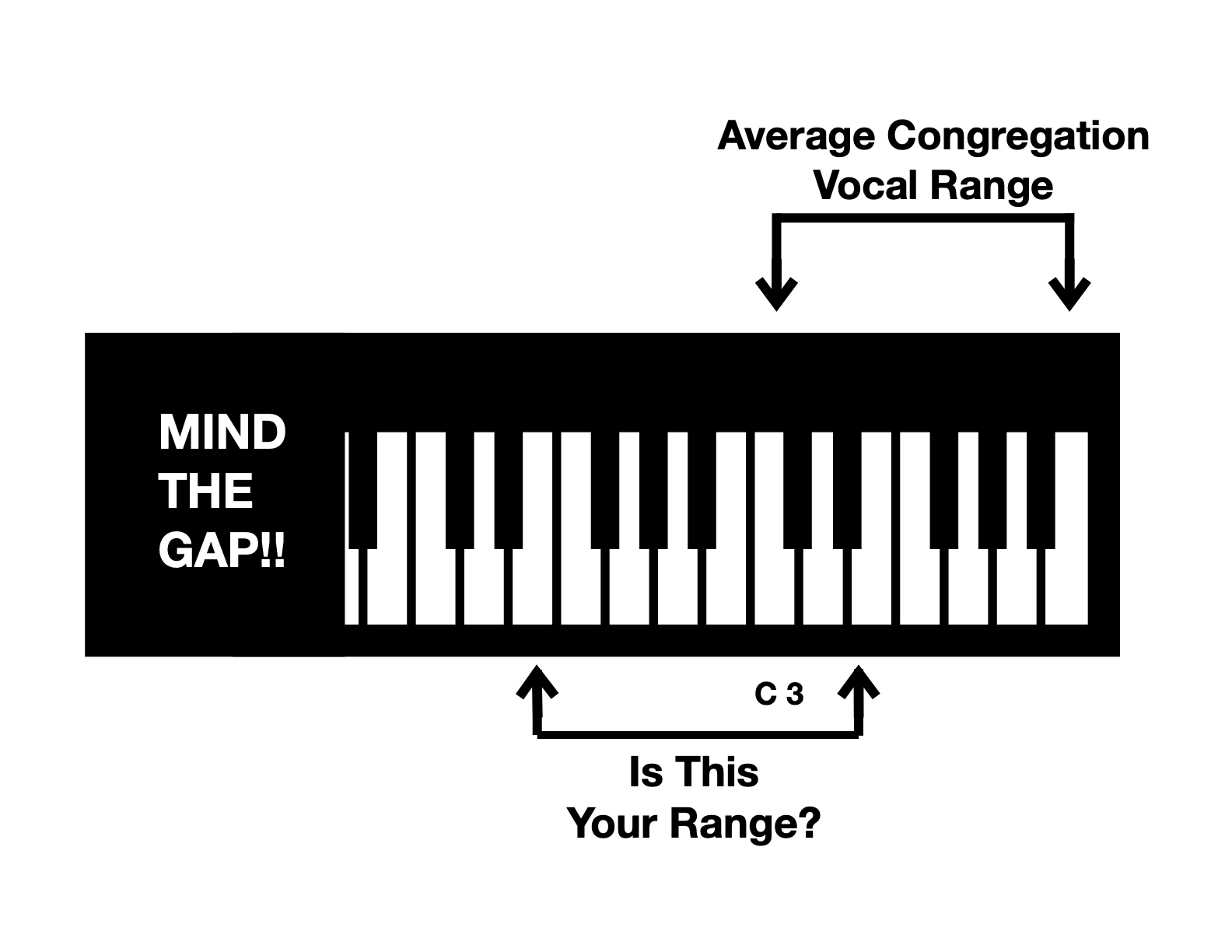
IMAGINE someone asking you to LEAD WORSHIP,
where…
every song you sing must be FOUR TO FIVE WHOLE-STEPS above your comfort range!
How would you feel?
T – I – R – E – D ! !

Now, imagine you are in the congregation, singing next to a group of people, most of them”Yo-Yo”-ing, trying to avoid singing in an uncomfortable range.
Could you keep this up?
Probably not. After a while, you might say to yourself:
“I think I will sit this one out”
Constant range adjustment and Yo-Yo-ing creates an imbalance: The verse is incorrectly placed in a very high range, and the chorus is sung in a low range,
which is the opposite of the songwriters intent!
This is a distortion of the method we use to emphasize the chorus and “worship moments” (bridge) in our songs. This constant readjustment is both tiring and discouraging, and most musicians know this is a situation that needs to be corrected.
THE CHALLENGE
Worshipers must be able to sing at FULL VOICE. And they must feel like they are contributing. That means they should feel like they are actually co-leading worship, not just listening.
THE SOLUTION
BRING BACK THE JOY OF WORSHIP:
YO-YO-ING CAN BE FIXED!
- First, you need to find the range of the average voice. Let’s look at that chart again:
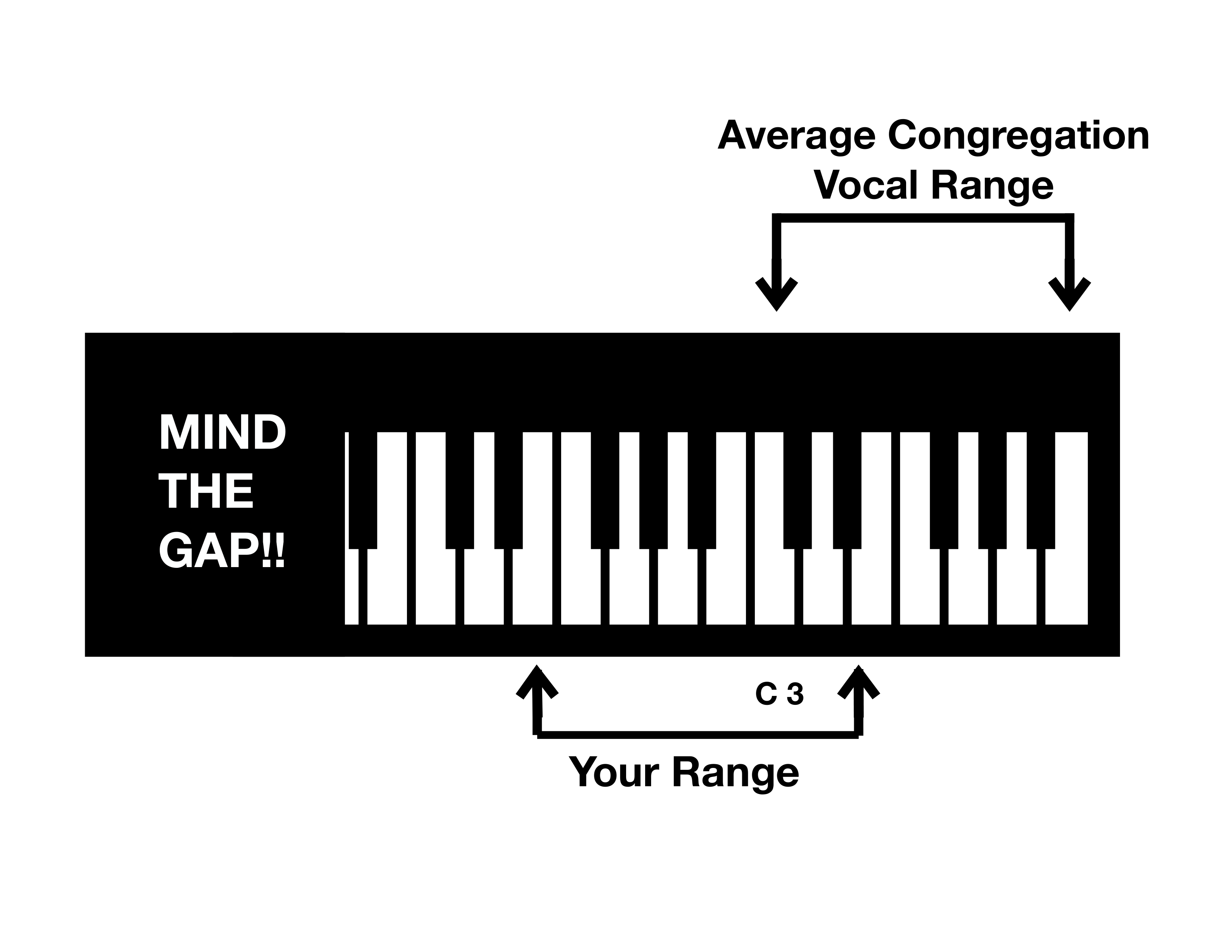
- Analyze the vocal range of a song you have chosen for Sunday, and notice the range of notes. Then move the range around the scale until you find a range that more nearly fits the “average” on the chart above. Decide what key you will need to play in. If you do not like playing in flats (or sharps), move the range up or down a half step. You should be able to find a key you can easily play in.
- Transpose your song. There are sheet music sites and apps that already have transpositions, and most likely your church subscribes to a service that gets your lead sheets to you on Sunday. You need to ask them what keys they offer in each worship song. If they don’t offer a variety of keys, do an online search and find an online music store that sells worship songs in a variety of keys.
- Test your key choice by having an alto or baritone in your team sing the song for you in that key before you purchase lead sheets for the whole band. They should be able to easily sing the verse in their low register, and the chorus higher register. Then adjust the sharp or flat key to suit your band.
- Order the music. This is an important step. You need new music for the entire band to read from. Put aside your old lead sheets in your own personal file, and save them for later, when you will need them for a solo. Make sure the new music is in a key that is comfortable for your band or accompanist as well as the average voice range of worshipers.
- Rehearse in the new key ONLY! If you are introducing a new song, you may need to play a sample of that song for your band first. If you can only find a recording in the key that is out of range for your worshipers, play it only briefly at the beginning of your rehearsal. Then put the recording and your old lead sheets away.
YOU NEED TO REHEARSE YOUR WORSHIP SONG IN THE CORRECT KEY
If the new key is not quite in your range, you may be feeling like you have been asked to give up the “sweet spot” of your voice by putting the chorus in a less powerful part of your range. If the chorus is in the high range for the average voice, it means you may be in your mid-to-upper-mid range. You will need to practice this and find ways to amplify the chorus without straining your voice. Get a little closer to the mic on the chorus, and try having team singers with average ranges duplicate your voice while you are singing the chorus, to create volume via a double or triple effect. This will add power.
As time goes on, and your worship gathering starts feeling more empowered, you can step away from the mic during one of the mid-song choruses, and they will take over. It’s a beautiful thing when that happens, and you will feel even more empowered when you step back up to the mic.
~aj






Leave a reply to WORSHIP MUSIC – ART OR SCIENCE? – Alpha and Omega Christian Songwriters Cancel reply